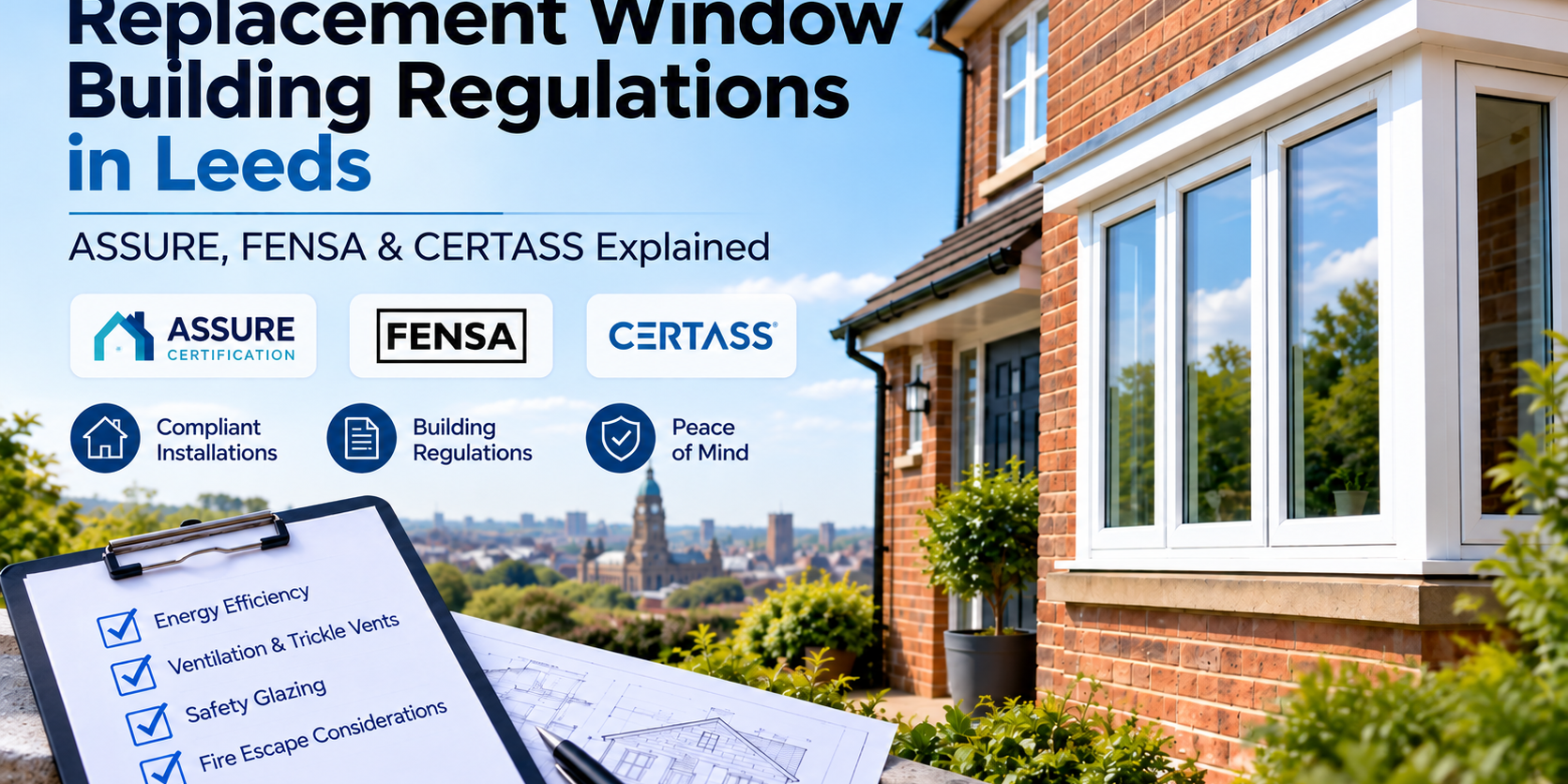
Do Replacement Windows Need Building Regulations Approval in Leeds? FENSA, CERTASS & ASSURE Explained
If you are replacing windows in your Leeds home, you may have come across terms such as Building Regulations, FENSA certificates, CERTASS and ASSURE.
It can be confusing, particularly because homeowners are often told they “need a FENSA certificate”. In reality, FENSA is only one of several government-authorised Competent Person Schemes that can be used for qualifying replacement window and door installations.
In most cases, replacing complete windows or external doors in an existing home must comply with Building Regulations. The work can normally be dealt with either by using an installer registered with an authorised Competent Person Scheme, such as ASSURE, CERTASS or FENSA, or through the appropriate building control process.
For Leeds homeowners considering replacement double glazing in Leeds, understanding this before choosing an installer can help avoid problems with compliance paperwork later.
Do Replacement Windows Need Building Regulations Approval?
Yes, replacing complete windows is generally classed as building work that needs to comply with the relevant Building Regulations.
This is different from simple repairs such as replacing a failed sealed glass unit while retaining the existing frame.
GOV.UK identifies replacement windows and doors as work that may need to be notified and approved, unless it is carried out by an installer who is able to self-certify qualifying work through an authorised Competent Person Scheme.
That means the important question is not simply:
“Will I get a FENSA certificate?”
A better question is:
“How will my replacement windows be certified as complying with Building Regulations?”
What Is a Competent Person Scheme?
A Competent Person Scheme, often shortened to CPS, allows an appropriately registered installer to self-certify certain types of building work.
Instead of the homeowner arranging a separate Building Regulations application for qualifying work, the registered installer can certify that the installation complies with the relevant requirements and notify the local authority through their scheme.
GOV.UK states that registered tradespeople can self-certify qualifying work and provide the homeowner with evidence of compliance. That documentation can also become important during a future property sale.
For replacement windows and doors, the government’s current list of authorised schemes includes ASSURE, CERTASS and FENSA, along with other approved scheme operators.
Is FENSA the Only Valid Certification for Replacement Windows?
No.
This is one of the most common misunderstandings surrounding replacement windows.
FENSA is a widely recognised name, which is why homeowners and even people involved in property transactions sometimes use “FENSA certificate” as shorthand for window compliance paperwork.
However, a homeowner does not specifically need FENSA if their installation has been correctly certified through another authorised Competent Person Scheme.
ASSURE and CERTASS are also government-authorised schemes covering qualifying replacement windows and doors.
The important point is that the installation has followed an appropriate route to Building Regulations compliance and that the homeowner receives the relevant evidence.
What Is FENSA?
FENSA operates a government-authorised Competent Person Scheme for replacement windows and doors.
A FENSA-registered installer can self-certify qualifying installations and register completed work through the scheme.
FENSA is therefore one legitimate route to compliance, but it is not the only route.
What Is CERTASS?
CERTASS is another government-authorised Competent Person Scheme available to window and door installers.
CERTASS installers can self-certify qualifying replacement window and door installations through the scheme, with the relevant Building Regulations compliance documentation provided for registered work.
For the homeowner, this means a CERTASS-certified installation does not become invalid simply because it does not have the FENSA brand name attached to it.
What Is ASSURE Certification?
ASSURE is also an authorised Competent Person Scheme for replacement windows and doors.
The UK Government includes ASSURE alongside CERTASS and FENSA within its list of authorised schemes covering qualifying replacement window and door work.
ASSURE-registered installers can self-certify qualifying installations as complying with Building Regulations and register completed work through the scheme.
Glass Tec Windows is Assure Registered, providing a recognised compliance route for qualifying replacement window and door installations carried out for our customers.
For homeowners, the important issue is therefore not whether the paperwork says “FENSA” specifically. It is whether the installation has been properly registered through an authorised route and the appropriate compliance documentation has been provided.
If you are considering new double-glazed windows in Leeds, this is something worth asking about before agreeing to an installation.
ASSURE vs FENSA vs CERTASS: Which One Do I Need?
For most homeowners, you do not need to choose your replacement windows based purely on whether the installer uses ASSURE, FENSA or CERTASS.
All three are government-authorised Competent Person Schemes covering qualifying replacement window and door work.
The more important considerations are whether your installer is currently registered with an appropriate scheme, whether the proposed work falls within that scheme’s scope, whether the installation itself complies with the applicable Building Regulations and whether you will receive the relevant documentation afterwards.
In other words:
FENSA is a scheme. CERTASS is a scheme. ASSURE is a scheme. Building Regulations compliance is the underlying requirement.
What Building Regulations Affect Replacement Windows?
Building Regulations do considerably more than determine whether you receive a certificate.
Depending on the installation, several areas of the regulations may need to be considered.
Energy Efficiency
Replacement windows need to satisfy the applicable energy-efficiency requirements.
Modern Building Regulations include requirements relating to heat loss and the thermal performance of windows and doors under Part L.
The exact specification required can depend on the type of work and the applicable Building Regulations guidance at the time of installation.
This is one reason homeowners should avoid choosing new windows based solely on the appearance of the frame or the number of panes of glass.
The complete window specification matters.
Ventilation and Trickle Vents
Modern replacement windows can be significantly more airtight than older windows.
That is beneficial for controlling unwanted draughts, but adequate ventilation still needs to be considered.
Part F of the Building Regulations covers ventilation. Depending on the property, its existing ventilation and the requirements applicable to the work, background ventilation may need to be provided as part of a replacement window installation.
The aim is to ensure that replacing windows does not leave the property’s ventilation less satisfactory than before.
A competent installer should therefore assess ventilation requirements as part of the specification rather than treating trickle vents as an afterthought.
Safety Glazing
The position of glass within a window or door can also affect the type of glazing required.
Part K of the Building Regulations deals with protection from collision, impact and falling. This includes requirements concerning glazing in locations where there is a greater risk of somebody coming into contact with it.
Depending on the position of the glass, an appropriate form of safety glazing may therefore be required.
Fire Escape Considerations
Some existing windows also contribute to the means of escape from a property.
When an existing window provides escape potential, replacing it with a new configuration should not unnecessarily reduce that provision.
This is another reason why simply ordering a different opening style because it looks better may not always be appropriate.
The position, opening size and intended use of a window can all matter.
Do Replacement Windows Need Trickle Vents?
This is one of the questions homeowners commonly ask when replacing windows.
There is no useful answer based solely on whether the windows are double glazed or triple glazed.
Ventilation requirements depend on factors including the existing ventilation provision, the room, the property and the Building Regulations requirements applying to the installation.
Current guidance places particular emphasis on ensuring that replacing windows does not leave ventilation less satisfactory.
A competent installer should therefore assess the ventilation requirements during the survey rather than automatically removing existing vents or assuming that leaving the window slightly open solves the problem.
Do I Need Planning Permission as Well as Building Regulations?
Planning permission and Building Regulations are separate systems.
Building Regulations primarily deal with matters such as safety, energy efficiency, ventilation and construction standards.
Planning controls are concerned with whether a particular development or alteration is acceptable from a planning perspective.
For many ordinary homes in Leeds, straightforward replacement windows may not require a planning application. However, additional restrictions can apply to listed buildings, conservation areas, properties affected by an Article 4 Direction or homes subject to specific planning conditions.
If the appearance of the property is protected or substantially changing, the planning position should therefore be checked separately.
Having Building Regulations compliance does not automatically mean that any necessary planning or listed-building consent has also been obtained.
What Certificate Should I Receive After Replacement Windows Are Installed?
If qualifying replacement windows have been installed through an authorised Competent Person Scheme, you should receive the relevant evidence showing that the installation has been registered through that scheme.
Depending on the installer, this could be documentation issued through ASSURE, CERTASS, FENSA or another authorised scheme.
If the work is dealt with directly through building control instead, the paperwork will follow that route.
Keep this documentation somewhere safe with the other records for your home.
It may be requested later, particularly when you come to sell the property.
Do I Need a FENSA Certificate to Sell My House?
You do not specifically need a certificate carrying the FENSA name if the windows were legitimately certified through another recognised route.
What matters is being able to demonstrate how applicable Building Regulations requirements were dealt with.
For example, qualifying replacement windows may have been self-certified through ASSURE, CERTASS, FENSA or another government-authorised scheme.
Alternatively, the work may have gone through the relevant building control process.
If you are selling a house and cannot locate the original paperwork, it is worth checking which scheme the installer used before assuming the windows were never registered.
What Happens if My Windows Were Replaced Without a Certificate?
Do not automatically assume that missing paperwork means the installation was never registered.
Certificates can be lost, particularly when windows were installed many years ago or when a property has changed hands.
If you know who installed the windows, start by identifying which Competent Person Scheme they were registered with at the time and whether replacement documentation is available.
If there genuinely is no record of compliance, the appropriate next step will depend on the circumstances.
A homeowner may need advice from the relevant building control authority and, if the issue arises during a property transaction, their conveyancer.
It is better to establish the actual status of the installation than simply assume that obtaining a particular branded certificate will solve the problem.
Are Glass Tec Windows FENSA Registered?
Glass Tec Windows uses ASSURE, rather than presenting FENSA as the only route to Building Regulations compliance.
Glass Tec is Assure Registered, and ASSURE is recognised by the UK Government as an authorised Competent Person Scheme for qualifying replacement window and door installations.
That means homeowners should not be concerned simply because their compliance documentation is issued through ASSURE rather than FENSA.
The important factor is that qualifying work is completed, registered and certified through an appropriate authorised compliance route.
Planning Replacement Windows in Leeds?
If you are considering replacing draughty, damaged or outdated windows, compliance should be part of the conversation from the beginning rather than something discussed after installation.
Glass Tec Windows manufactures and installs made-to-measure REHAU windows for homeowners across Leeds and West Yorkshire.
As an Assure Registered installer, we can explain the relevant compliance requirements associated with qualifying replacement installations, along with your choice of frame style, glazing specification, ventilation and security.
You can explore our double glazing in Leeds service to learn more about our window options, manufacturing process and installations across Leeds.
Alternatively, contact Glass Tec for a free, no-obligation quotation for replacement windows or doors.
Frequently Asked Questions
Is ASSURE the same as FENSA?
No. ASSURE and FENSA are separate organisations, but both operate government-authorised Competent Person Schemes covering qualifying replacement windows and doors. CERTASS is another authorised scheme.
The important requirement is valid Building Regulations compliance and registration, not the use of one particular brand name.
Is a CERTASS certificate valid when selling a house?
A properly issued CERTASS Building Regulations Compliance Certificate provides evidence of compliance for qualifying work registered through the CERTASS scheme.
CERTASS is an authorised Competent Person Scheme for qualifying replacement windows and doors.
Is an ASSURE certificate accepted for replacement windows?
Yes. ASSURE is a government-authorised Competent Person Scheme covering qualifying replacement windows and doors.
Qualifying installations registered through an ASSURE-certified installer can therefore follow an authorised self-certification route.
Can I install replacement windows myself?
You can replace windows without using a Competent Person Scheme installer, but where the work is notifiable you will normally need to use the appropriate building control route rather than self-certifying the installation yourself.
Are replacement glass units covered by the same rules as replacing an entire window?
Replacing only a failed or misted sealed glass unit while retaining the existing frame is different from replacing the complete window.
The Building Regulations notification requirements applying to complete replacement windows should therefore not automatically be assumed to apply in exactly the same way to a glass-only repair.
Is planning permission the same as Building Regulations approval?
No.
Planning permission and Building Regulations are separate.
A window installation can potentially satisfy Building Regulations while still requiring separate planning or listed-building consent because of the property or proposed alteration.
Do new double-glazed windows always need trickle vents?
Not simply because they are double glazed.
The applicable ventilation requirements depend on the property, existing ventilation and Building Regulations requirements applying to the installation.
This should be assessed during the survey.
Building Regulations and government guidance can change. This guide was reviewed in September 2026 and is intended as general information rather than project-specific building-control or legal advice.